If you thought the whole dreadful saga of KTM had been buried with the rescue by Bajaj, we now have the news that staying out of court again maybe their latest hurdle they need to overcome.
The headlines read “KTM’s trickery”, and “The motorcycle nobody wants”. And to be fair that sounded a bit harsh, until I actually started reading the articles.
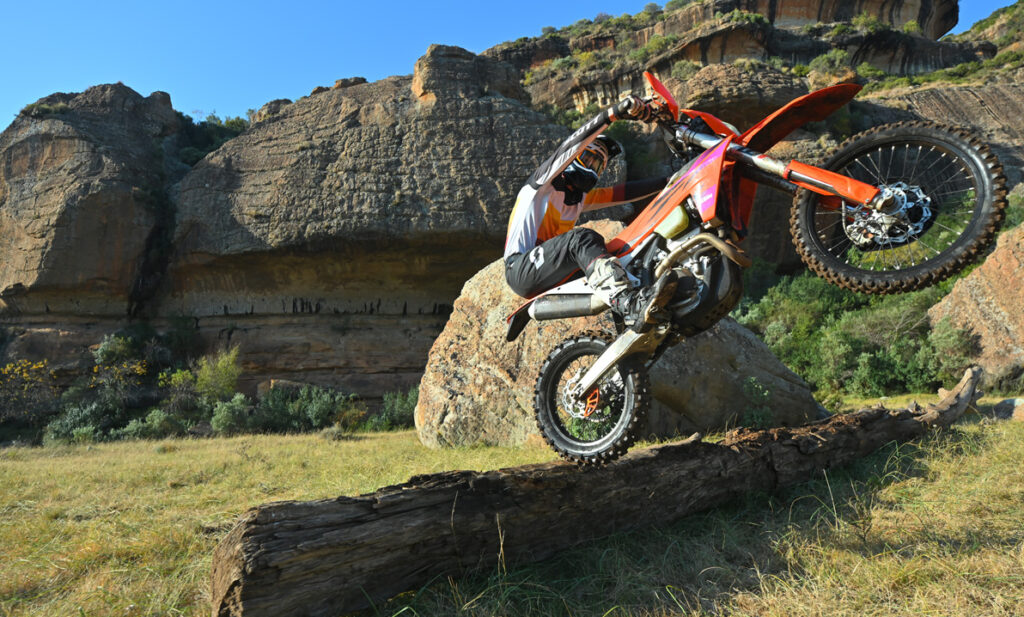
As we all know, KTM was always a brand known for enduro motorcycles and other off road bikes. It is only relatively recently they expanded into the realm of street bikes, but to say they seem to have been blurring the line seems quite apt here.
Because they have been caught selling Enduro bikes with registration plates that should never be registered for the road.
International Investigations
Investigations by several organisations reveal a potentially illegal system they have put in place, and yes for legal reasons I have to say potentially, but the system is real, and illegal, and it puts many riders in the uncomfortable position of falling foul of the law as well as showing a company flouting Germany and the rest of the EU’s environmental regulations, and at the same time throwing their dealers under the bus.
Now YOU might think that sounds harsh, but as you listen, you may begin to understand why I have said it.
DER STANDARD, in cooperation with nine other media outlets, including Le Monde, El País, Der Spiegel, ORE, and ZDF, conducted 15 seperate undercover investigations in seven countries as part of an international probe, and the results were not good for KTM.
The project was coordinated by the whistleblower protection organisation Climate Whistleblowers, and the investigation is not alone either. There are other parallel investigations I will come to later, but this all starts in Germany, because it was in Germany that the bikes were type approved for use on the road across the whole of Europe by the German Federal Motor Transport Authority.
The investigation confirms that KTM off-road motorcycles, arrive at dealerships with a restricted power output, but are then modified at the dealers, ready to be ridden off the premises by customers, in an illegal condition.
The crimes potentially involved will include falsifying legal documents. This effectively makes the registration documents invalid.
It puts the German Transport Authority in the firing line from other Transport Authorities across Europe, and jeopardises their position as a bastion of the ideal that rules should always be followed.
An Open Secret
Now you might say, “Yes but everyone knows that”.
The point is, the German Transport Authorities, politicians and law makers, and the various police forces across Europe didn’t, and now they do, and they have a trail of documentation to show them why.
That puts the whole system in jeopardy, and it is riders who will become the target at some point make no mistake.
You see, it all revolves around the restrictions that are lawfully needed for “Enduro” bikes to be registered as road legal in Europe. The laws may well be slightly different elsewhere, but this investigation was based in Europe, and its ramifications will affect the whole industry.
The law relates specifically to the use of bikes registered as Enduro bikes for use on the road.
You may not know, but certain KTM off-road motorcycles arrive at dealerships restricted in power. There, they are modified, and are ridden off the premises by customers in what is technically an illegal condition.
That means it is the customer doing the riding that may well therefore be committing a criminal offence. And I’m sorry for the words “May” and “Potentially”. Those statements may well come up a lot today, I have to choose my words carefully here.
One investigator who was also a potential customer asked the salesman of a KTM dealer in eastern Austria about a KTM 350 EXC-F. He was genuinely interested in the bike, but specifically asked whether it was really not ‘restricted”?
The bike needed to have a license plate, so the law states that to be registered, it needed to be restricted,
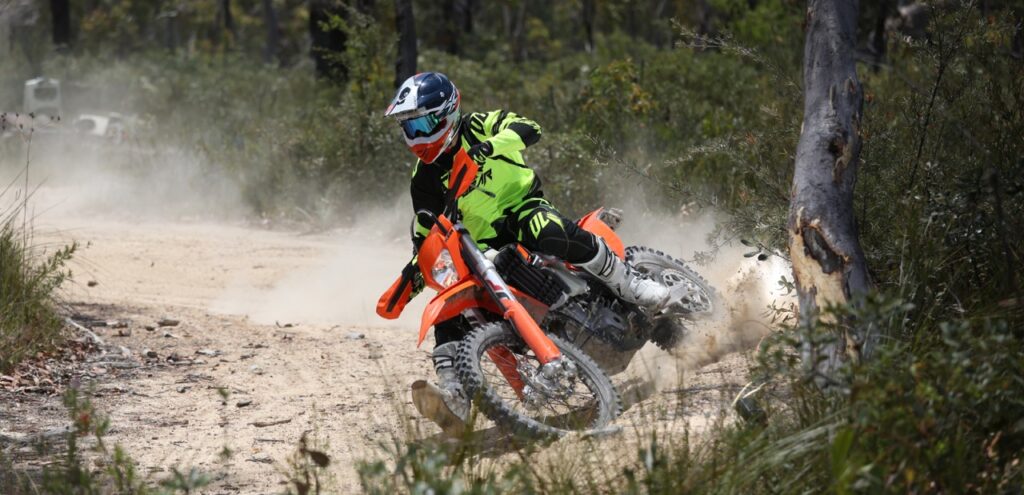
The customer explained he needed it registered, but he didn’t really want it restricted, and instead of the 15hp legal limit, he wanted the full “Ready to Race” 50 hp orange fireball.
This is impossible legally as these off-road motorcycles are only permitted to be registered when restricted.
The seller was unphased, saying “There is no restricted version, if you rode it restricted, it would fall apart after 20 kilometres.”
He continued “The restriction is only to get it registered, once registered, it doesn’t matter anymore”.
In other words, although riding this motorcycle on public roads would be illegal, in the dealers words “Nobody rides a restricted one”, and the laws aren’t enforced.
Now to a certain extent we know all of this, but the point is, now it is all out in the open, and it is considered a flagrant violation of both national law in Germany, and the laws in the European Union.
Legal Ramifications
There are bound to be ramifications in other countries too.
An employee of another KTM dealer in northern Germany also leaves no doubt during another undercover operation organised by ZDF.
They said that “the restricted factory settings are really only for registration”, and that “nobody would enjoy it otherwise”.
But without these restrictions, these bikes are illegal from the Transport Authorities perspective.
In a parallel enquiry Peter Mock of the International Council on Clean Transportation, revealed that SHOCK HORROR, the bikes are significantly louder than permitted and also emit far more pollutants. In particular, carbon monoxide levels were off the scale.
He said “The measured values for the unrestricted version were roughly as high as those of an old diesel locomotive”, and I think that is maybe a bit exaggerated, but this just so happens to be the environmental organisation that blew the whistle on the VW emissions scandal all those years ago.
Nevertheless, KTM – the undisputed market leader in the segment, have been putting these bikes on the road by the thousands for years by playing the system.
According to Statistics Austria, around 11,000 enduro motorcycles from KTM and its sister companies GasGas and Husquarna were registered just in Austria in 2025.
KTM HQ came back with the statement, “the study results refer to a configuration that ‘expressly does not correspond to the delivery condition of the motorcycles, and they are not intended for road use in this form”.
So let me get this right. KTM sells a restricted bike to the dealers, so they can register them for the road, but they include all the parts to de-restrict the bike in the packing crate.
Then say “They aren’t intended for road use?”
Well if they aren’t intended for road use, why bother restricting them in the first case?
Anyway.
Part of the problem here is that in the world of owners and forums, this is a very open secret, but because of that, the authorities can see trails of evidence everywhere detailing all that KTM, the KTM dealers and owners have been doing.
A Lawyers Perspective
One of the files was from Alexander Letitzki, a lawyer with the Austrian Automobile, Motorcycle and Touring Club.
In his statement he says “there’s no way to tell with the naked eye whether such a motorcycle is restricted. For that, you’d need to be able to read the software, but the relevant testing centres don’t have the testing equipment”.
This was reinforced when the Austrian Automobile Club explained that “a specific search for hidden engine modifications is neither planned nor realistic.”
Mr Letitzki continued, “The motorcycle is completely unusable as it comes from the factory. It’s like giving you a bicycle without pedals; it just won’t run.”
Reported in L’Espresso, a KTM dealer in Northern Italy stated that “The vehicle inspection sticker isn’t considered a major hurdle in the scene. Riders openly discuss the details in forums and how to get around them.
The common practice as we all know is just to install the restrictor for the inspection, and then remove it again afterward.
When asked, the inspection agencies deny any responsibility.
And this is the dilemma now for all concerned. Who is actually going to be held responsible?
KTM? The Dealers? Or the owners?
What is certain, is that anyone riding an unrestricted motorcycle on public roads is now not just committing a driving offence. They may well be looking at criminal proceedings.
And if the bike is insured for road use, if any claim is made it is likely to be challenged or denied by the insurance company.
In the words of Armin Kaltenegger a lawyer with the Austrian Road Safety Board It definitely amounts to insurance fraud, because the insurance only applies to the motorcycle in its registered, restricted state.
Kaltenegger explained that manufacturers and dealers face significantly higher penalties now if this offence is part of their business model.
Le Monde reported it as KTM trying to cover its bases.
The owner’s manual states that the motorcycle is only approved for public road use in its restricted version.
However, as we have heard earlier, in this state they are barely rideable.
The dealers in turn, have customers sign a “conversion order”.
This confirms that the modification was carried out at the customers request, and so puts the blame squarely on the shoulders of the owners.
According to one dealer, speaking to the STANDARD, they said that “The dealer’s employee’s just try to explain and inform the customer’s as best as they can.”
In the end, it is the riders who get caught who are ending up in the firing line, as always.
One Owners Voice
One KTM owner was accepting, saying “That’s just how it is, always has been, and always will be, and if you do get caught? Take it like a man,”
The trickery is all about the company and dealers being able to sell bikes into a market that they really just aren’t legally fit for.
For those that don’t know, the scheme works like this.
KTM delivers restricted motorcycles to its dealers, but includes all the necessary parts for the conversion in the same box. The dealers then modify the bikes and make adjustments to the KTM software to de-restrict them and make them “Ready to Race”.
Any skilled home mechanics or riders can perform the conversion themselves, but the bike will need unlocking by an authorised KTM dealer, and that is part of the issue, because at this point, KTM are aware that the bike is unrestricted and should legally notify the authorities and the registration plate be withdrawn.
The manufacturer is informed in real time about every “de-restriction” of a road registered bike, and it is their legal duty to report the changes to the various regulatory bodies in each country.
This however, is what they have not been doing, and I think we can all agree that the likelihood is, that this is a company decision made purely to make sure they don’t miss out on sales, and be left with a fleet of bikes that would sink the titanic, that simply aren’t legal to sell anywhere within Europe.
An undercover visit to the Brussels Motor Show in January revealed that KTM employees are very well informed about the whole process, and happy to talk about it openly.
A reporter from the French newspaper Le Monde talking to a KTM sales representative was told, “KTM initially designs its motorcycles to be as fast and efficient as possible – but then, unfortunately, they have to modify them to meet the legal homologation and emissions standards”.
But he explained, “The dealers, just reverse the modifications, It’s a bit of a cheat, but everyone does it”.
German environmental lawyer Remo Klinger, who successfully sued the German environmental organization Deutsche Umwelthilfe in the VW/Audi diesel car scandal said, “This is ‘grossly unlawful and totally illegal. It is clear manipulation of the regulations, and it is the duty of these manufacturers are obligated to inform the relevant authority if potentially manipulated vehicles are to be used on the road”.
A Challenge For The Authorities
In this case, because KTM had the models approved in Germany for Europe wide use, the German Federal Motor Transport Authority (KBA), are the ones in the tricky position. They have to decide who has broken what laws and raise prosecutions, and it has now been confirmed that they have announced a full investigation, but this will likely take years.
As usual, KTM have not answered the numerous questions this raises in any detail, but they did make the statement that has become a bit of a mantra. “The KTM Group delivers all models to its authorised dealers in a ‘street-legal condition”.
The dealers, who let us not forget, are given all the parts for de-restriction, pointed out that removing the restrictions makes the bikes not legal for road use and technically invalidates the vehicle’s registration.
So they are admitting their part in it all.
This means it is no longer legal for the bikes to be used on public roads, and they advise all customers of that fact. They should and probably are advising KTM of the modifications, and in turn, KTM has the responsibility to advise the relevant authority that the bike is no longer fit to be registered.
They added that modifications to the bikes for competitive use are only possible “at the express request” of “motorsport oriented” customers.
But the undercover operations paint a very different picture.
At dealers in most of the countries where the investigations took place, the enduro motorcycles were sat in the showroom already unrestricted. Ready to be sold to anyone with the cash to buy them, complete with a registration plate, despite the full power conversion.
It is an open secret in the industry, and it’s not just KTM enduros that are being modified illegally for road use. Both of KTM’s sister companies Husqvarna and GasGas also offer street-legal enduros, as do many competing brands.
A former workshop manager at a KTM dealership went as far as to say that none of the so called street legal enduros are really legal to ride on the road.
It isn’t long ago that KTM repeatedly hit the headlines with major financial difficulties, and this was driven at least in part by the massive backlog of unsold bikes.
The company only survived insolvency thanks to a big cash injection in the form of a loan from the Indian investor Bajaj Auto.
But it was just a loan, and still needs paying back.
In return, Bajaj acquired a controlling majority in KTM’s parent company, Pierer Mobility, and according to its own figures, the company, headquartered in Mattighofen in Austria, sells several hundred thousand of these Enduro motorcycles each year.
Most of them are sold as restricted Enduro bikes, then registered for road use, and de-restricted.
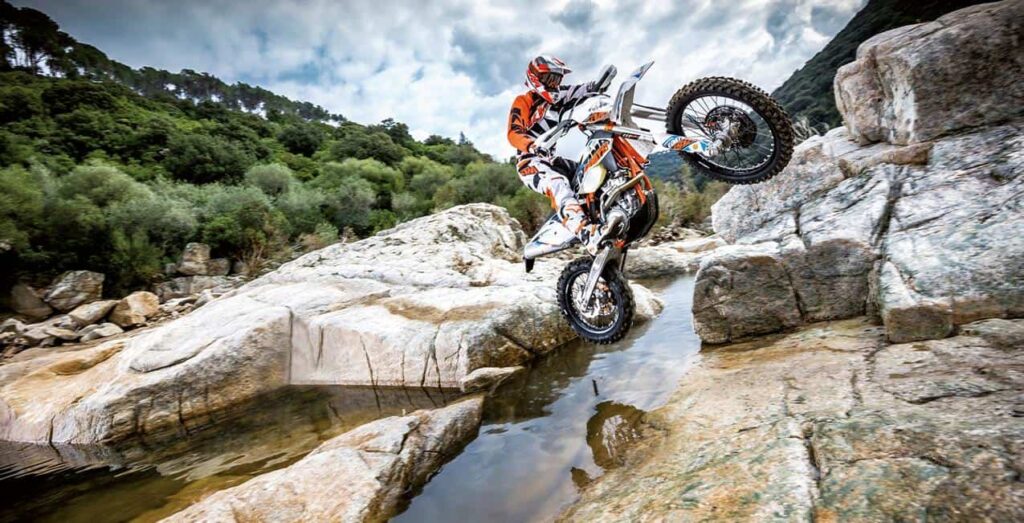
The reality is, Enduro bikes aren’t really built for the road. They are designed for off-road tracks, crossing dirt roads, rocks and streams.
On race tracks and private training ground, enduros can be ridden without any restrictions, so some experts dismiss this whole argument, saying that these machines are simply sports equipment and that nobody would enjoy riding them on the road.
But if that were the case they would all be sold unrestricted with no registration.
For those who want to cover longer distances, Enduro motorcycles are rarely the weapon of choice for the masses, but registration does have advantages for owners.
Bikes without a roadworthiness certificate can be difficult to insure against theft or accidents in some countries and in most places it is difficult to link trails together without some road riding, and without a registration plate it can all get very messy very quickly.
Anyone riding any bike without a license plate will immediately attract unwanted attention and if any mishap should happen, technically any insurance is null and void.
Even in racing it gets complex. Some enduro races require registration, but nobody checks whether the bikes are restricted and truly road legal. If they were, with everyone starting the race with a restricted engine, it would be a very slow race, and no one checks.
All that is needed to enter, is the registration document.
So the majority of the sport is run with bikes that are technically illegal.
Then you get what now seems like endless streams online, of people riding these exact same bikes converted with Supermoto wheels and tuned to the hilt, riding like lunatics with no thought of restrictions or compliance with any legislations.
All in plain sight.
The reality is that most testing centres don’t have the equipment or technical skills to read the software, so most people think it is simply not a problem, and it isn’t.
Until it is.
Blown Wide Open
This issue has now been blown wide open and is plainly not only in the sight of the general public, but also under scrutiny by the various law-lords in countries all over Europe and beyond.
The testing centres will not be blind forever.
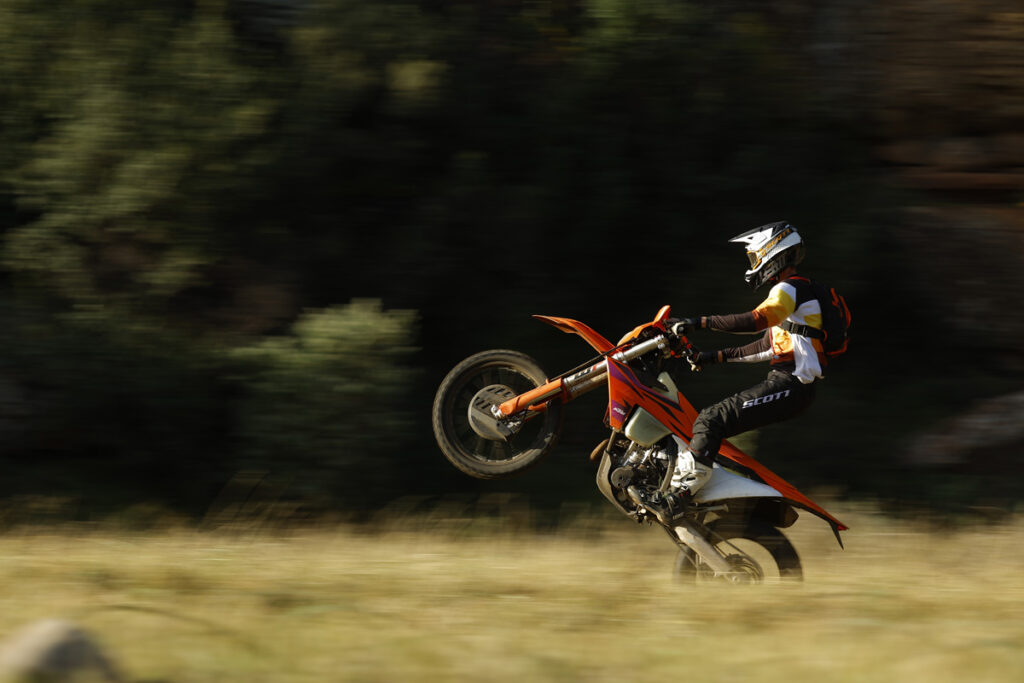
Going back to the ZDF investigation I spoke about earlier. A few weeks after the reporter’s initial undercover visit, the new KTM enduro motorcycle he bought was delivered, and in the typical bright orange and black livery, the machine was ‘ready to race,’ as the KTM slogan promises.
What that means is that it was derestricted, but still registered. A fact the customer had to confirm with a signature on a ‘conversion order’ and although it no longer complies with legal requirements, it stands there complete with its registration plate, ready to race, but licensed and ready for the road.
This “Ready to Race” tagline is the marketing statement that the whole brand is built on, and the work is all done prior to purchase, while the bikes are still in the showroom, and at no time has the company or its subsidiaries ever notified any of the authorities concerned as the law states that they should.
The dealer explains, he deliberately leaves the lambda sensor, a crucial component of the restriction, in place. Otherwise, the illegal modification would be immediately obvious to the police.
So the dealers are deliberately misleading the authorities so they can sell more bikes. Now on one hand I can understand this entirely, but it is a direct violation of the regulations and they can’t pretend they were unaware when they are deliberately disguising the modifications.
The probe is no longer functional, because the connecting cable leads nowhere, but that hasn’t seemed to matter, yet.
But now the clock is ticking.
Legal precedents will be trialled and someone will begin to be prosecuted, who that will be is a different question. But it will inevitably hit the order books of not only KTM, but GasGas, Husqvarna, Sherco, Rieju, Beta and more.
As awareness grows in the corridors of power, the loopholes will inevitably be closed, whether gradually or with one fell swing of a big axe.
So be warned, the changes may well affect the way many of us ride and the consequences of an increased focus on enforcing regulations could hit many riders and some manufacturers.
It could reset the 2nd hand market too depending how the laws are enforced.
With KTM, now under the ownership of Bajaj, with much of production moved to India and still running on massive debts, the future is still questionable to say the least.
Remove all the order books on European Enduro bikes and there is a big hole in sales, and a big pile of unwanted bikes.
Bajaj have said already they have little interest in racing, and the off road bikes that were once the bread and butter of KTM are now eye wateringly expensive compared to many others.
Will the company ditch that part of the market that they have dominated for so long?
If they do, they risk ending many lifelong relationships with the ones who bleed orange.
Selling them as expensive hand built bikes may be difficult when the road bikes that are built down to a price in India have the same badge on.
It doesn’t matter how many times you win. If your road bikes don’t live up to that same image, they won’t sell long term.
Where Bajaj is much more likely to make some money, is with the small capacity adventure bikes and their road going counterparts.
These are much less problematic legally and can be sold into a worldwide market.
We know already that the 490 twin project has been resurrected and will probably be on pre order if not in the showrooms by 2027 and the global launch of a new for 2027, 790 Duke has now begun.
Where do you think KTM’s future lies?
Or do you think this will be the last nail in this once great companies coffin?
I hope that makes sense, let me know your opinions in the comments below.
Where do you think the European Enduro industry is heading?