Well this one caught me blindsided and im really not sure how the R&D department came up with this when they were laid off most of the year, but I guess it’s a case of get the patents in early to cut off the chance of anyone jumping ahead of them.
And if I was cynical, I might say, “Then they can get us to do the R&D”.
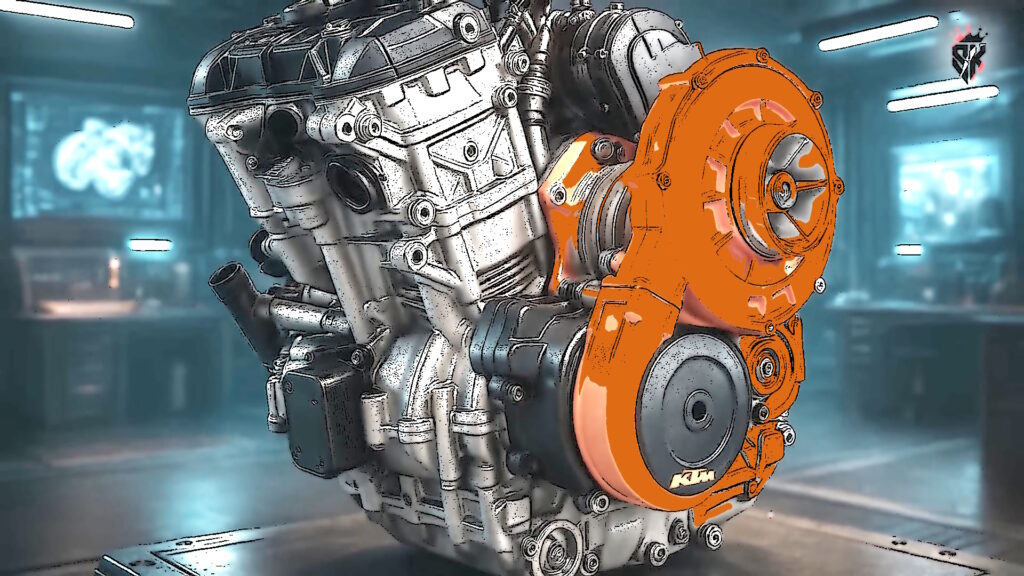
Anyway, KTM have dropped some pretty wild patent filings over the years, and lately they’re working on something I honestly didn’t see coming. A hybrid electric supercharger. Yeah, you heard that right. And before you roll your eyes thinking it’s just another gimmick, let us look at what they’re actually doing because it’s, well, it’s pretty clever.
So here’s the nitty gritty.
There is a whole forced induction renaissance happening in the motorcycle industry. Kawasaki have been doing their thing with the H2 series for about a decade now with no competition. Now Honda have been messing around with a fully electric supercharger, and Yamaha have got patents in place for electric-assisted turbos.
But KTM?
All of them are trying to solve a problem that’s been defeating engineers forever.
The question, “how do you get the instant throttle response of an electric system AND the efficiency of a mechanical one without the downsides of either?”
This matters because the EU’s is hammering everyone with Euro 5+ emissions standards, and Euro 6 is coming down the road. That means manufacturers need smaller, more efficient engines that will still make the power people want.
Forced induction lets you do that – you can take a 600cc engine and make it perform like a liter bike, but in theory, with better fuel economy and lower emissions.
The problem is, traditional superchargers are always parasitic. They constantly rob power from the engine, especially at low RPM. On a race bike that isn’t so much of an issue, but high rpm’s aren’t where most of us do most of our actual riding, and won’t help the fuel economy so sort of defeats the object.
Before I go on, I have to say a quick thank-you for all the support, and especially to the BareBonesMC family on the Ko-Fi page.
You can find more videos there, and on the Rumble channel, as well as on the back up channel here on youtube, but for now, grab a cuppa and settle in.
If you are watching on a mobile, please try and give the video as many HYPE points as you can, as youtubes latest addition to its algorithm is now taking centre stage on importance, even though it is only available on mobile so far.
Now, Kawasaki’s approach with the H2 lineup is pretty straightforward. They’ve got this centrifugal supercharger that’s mechanically driven straight off the crankshaft through a planetary gear setup.
The supercharger spins at 130,000 RPM. That means the blades of the turbine are moving faster than the speed of sound.
It works, don’t get me wrong. The H2 makes 240 horsepower, the track-only H2R pumps out 322. But here’s the catch. The system is heavy and so are the bikes. The H2 SX weighs 276kg or 610 pounds wet. And because that supercharger’s always connected to the engine, it’s always working, whether you need it or not, and even with the best bearings in the world, anything that spins at a constant 130,000 rpm is going to wear its bearings out sooner or later.
Honda is taking the opposite approach with their V3R concept. They’ve gone full electric with their supercharger. There is no mechanical connection to the engine at all. Just an electric motor spinning a compressor.
The beauty of this setup is instant response, Zero lag, and full boost from idle. Plus you can package it anywhere since you only need power cables and an air line. But the downside again is weight.
You need a hefty electrical system with a battery to keep it spinning, especially under sustained load.
Yamaha is doing something in between with their electric-assisted turbo patents.
They are taking a regular exhaust-driven turbo and adding a small electric motor to pre-spool it at low RPMs.
Once the exhaust flow gets going, the electric motor backs off. It’s elegant, but you’re still fundamentally dealing with a turbo and all the heat and packaging challenges that come with that.
Burn’t legs are no fun.
Now we get to see KTM’s solution.
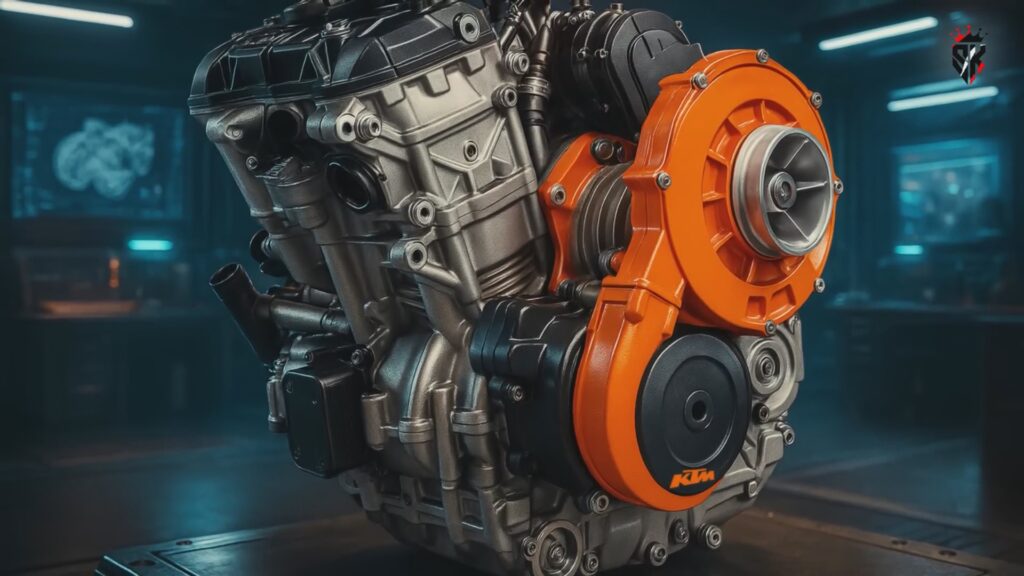
Which to be honest looks pretty brilliant in theory.
They’ve patented what they are calling an H-Supercharger. The H stands for hybrid, but its the supercharger that is hybrid not the bike so don’t worry.
It works by using a scroll-type compressor that can be driven by either an electric motor OR mechanically driven through a chain drive from the engine.
The key is an electronically controlled clutch that sits between them.
At low revs when pulling away the clutch stays open and the electric motor spins up the compressor instantly, giving you immediate boost without any lag.
As the engine speed climbs where you need sustained power, the clutch closes and connects the supercharger to the crankshaft so it is being driven mechanically like a traditional supercharger.
That way you are not draining the battery, so a smaller lighter battery is fine. But here’s the really clever part. When you’re cruising or backing off the throttle, that electric motor works as a generator, actually charging the battery using the rotation of the supercharger.
They say it can also run using electric only, mechanical only, or both together for maximum boost.
The patent shows it on what looks like a single-cylinder enduro bike, but they specifically mention it can work on any combustion engine.
Now, is this actually going to work in the real world you may ask. That is the million-dollar question.
The concept looks sound. You get instant low-end response from the electric side and efficient high-RPM performance from the mechanical side. The regenerative charging means you really don’t need a big battery either, which would help lower overall weight.
However, there is a lot of complexity here and integrating the systems will be no easy task.
You’ve got an electric motor, a second clutch system, control electronics, and the supercharger assembly itself. That’s a lot of stuff to break, and it has to mean more weight, and more cost.
And let us not forget, KTM is in a period of transition.
Ownership is still in a state of limbo and Rajiv Bajaj seems to have very different ideas about the companies future than the present management as I talked about in the previous KTM news video which included translations of some previously unaired interviews in German.
And understandingly, KTM hasn’t exactly been on time with their new product launches recently.
The 990 Duke R and 1390 Super Duke GT have both been pushed back to 2026 or maybe even 2027. So even if this hybrid supercharger works perfectly, you shouldn’t be expecting to see it in your local showrooms anytime soon.
What I find interesting is that despite all the financial woes and all the questions about their future that they still seem to be hedging their bets against whatever direction the market goes.
They tried and took a massive financial hit with the electric bikes, yet rather than sticking to their core market and making sure they are well served with good quality bikes that aren’t a pain in the ass to own, and parts supply to keep them going, now they are looking at this system of hybrid forced induction that I really can’t see finding a place in the dirt bike market.
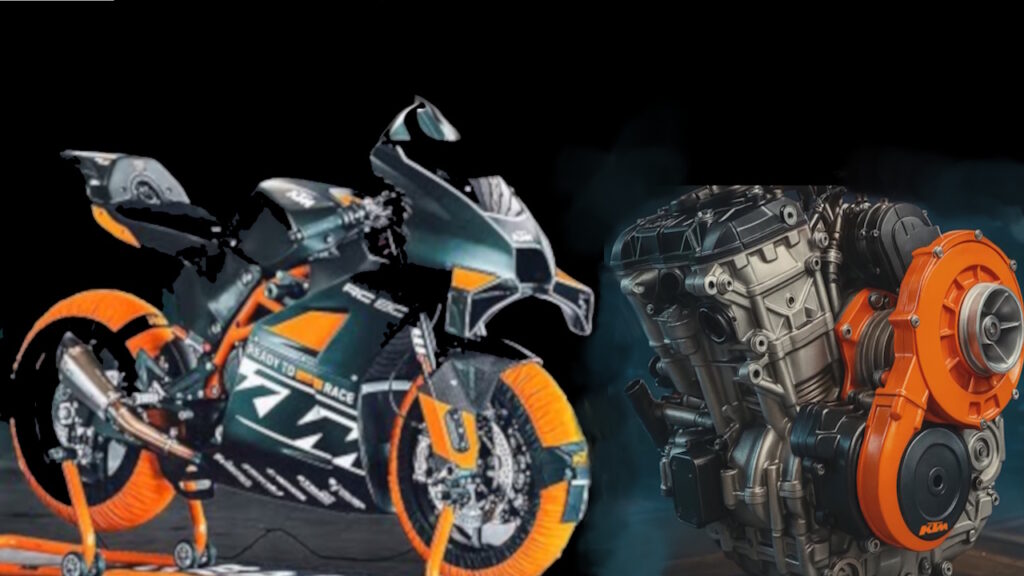
The automotive world is already doing similar things to this. Mercedes has electric-assisted turbos in their AMG models, Porsche is using eTurbos in the new 911 GTS and Audi have gone with fully electric superchargers.
So the technology is moving forward and it does work. But will it work on motorcycles?
You could say it’s just a matter of scaling it down and making it cost-effective, but that is a big ask while staying within a competitive price bracket, and when the de-facto new owner Rajiv Bajaj has already said costs need to be cut, where will this new prototype engine fit in?
Will we have a 300HP plus 1390 Xtra Duke RRR?
That sounds very expensive, and doesn’t sound like a bike that would have mass market appeal to be honest.
You can imagine a Super Duke built like this would have brutal low-end torque and a screaming top end, but where would anyone actually be able to use that power? And could they build it without turning the whole bike into just another overweight hippo.
Could it be used practically for a street bike?
Could we get that power without the weight penalty of a bigger engine?
It isn’t really a system I can see being popular in the world of global adventure riders either. Most of the riders I know have been screaming for less new untested tech on bikes not more.
Could an adventure bike with a supercharged engine work? Having instant low end response would be great, but all that complexity in the Sahara desert doesnt necessarily seem like a match made in heaven to me.
The patent does show it on a single-cylinder bike, but could it ever make sense for off-road riding where simplicity and light weight have always been king.
All in all I can’t say that I am too optimistic about this project ever coming to market, but it is interesting to see what they have been up to in the back room at Mattighofen.
KTM have tried weird stuff before. Sometimes it works brilliantly, sometimes not so much.
This hybrid supercharger could be a solution that finally makes forced induction work properly on motorcycles, addressing all the historical problems of lag, weight, and efficiency. But it could be an over-engineered white elephant, a solution to a problem that doesn’t really need solving.
It is interesting to see companies doing something other than just slapping a bigger motor in a bike and calling it faster, and the fact that multiple manufacturers are all working on different forced induction approaches tells me that this is likely to be the direction that the industry is heading.
Emissions regulations are getting tighter every year, and riders still want performance. This might be how we keep internal combustion engines relevant in an increasingly electric world.
So there you go. That is KTM’s hybrid electric supercharger in a nutshell.
Clever engineering, lots of potential, but also lots of potential problems, which is the last thing KTM needs right now.
Whether it makes it to production and actually works as promised remains to be seen.
What do you think?
Is this the future of performance motorcycles, or just another complicated solution looking for a problem?
Let me know your thoughts in the comments.